Why founders should own their product video narrative before hiring an agency

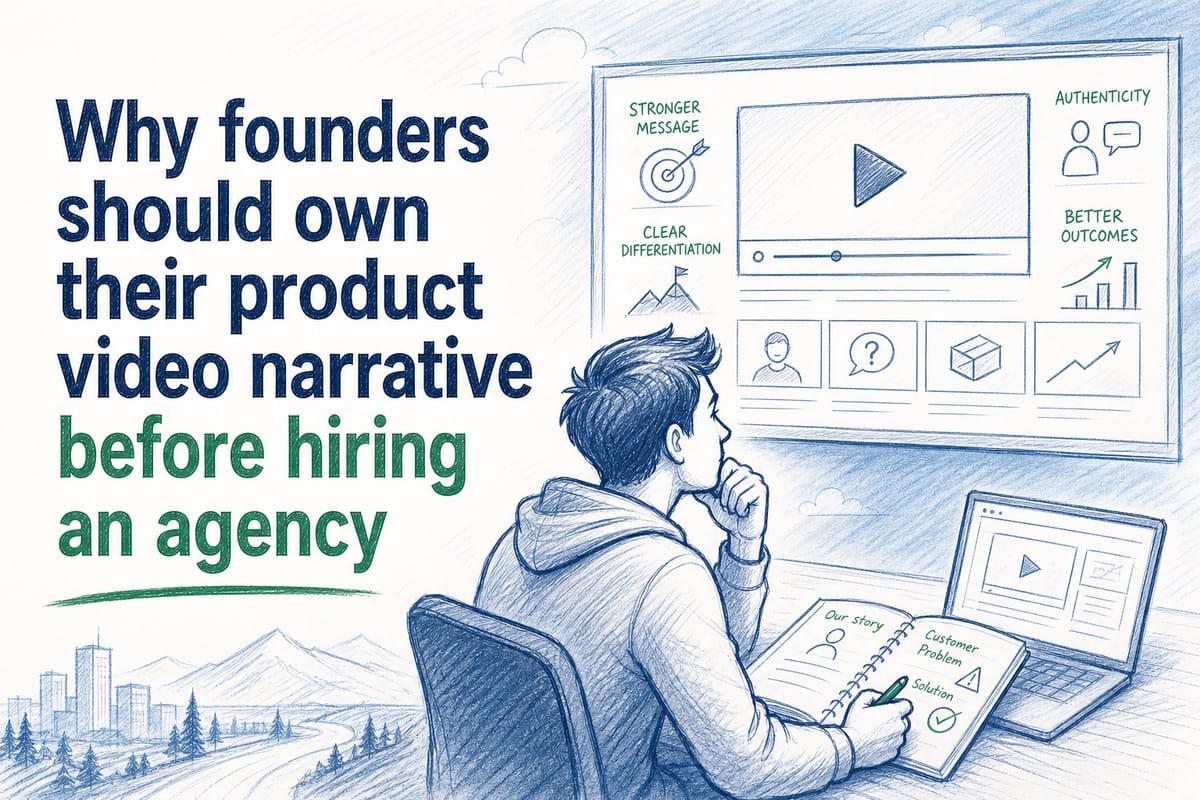
Table of contents
1. Why the narrative has to come from you first
2. What a strong founder product video narrative actually includes
3. How to work with an agency or a production tool once your narrative is solid
Most founders I talk to hand off their product video to an agency too early. They share a one-pager, jump on a 30-minute call, and trust that a production team will figure out the story. Six weeks later, they get back a polished video that looks great but somehow misses the point. The demo flow is off. The narration buries the core value prop. The UI shown is already two sprints old. That outcome is not the agency's fault. It happens because the founder never owned the founder product video narrative before the handoff. This article explains why that ownership matters, what it actually looks like in practice, and how to build a narrative foundation that keeps working even after your product changes.
Why the narrative has to come from you first
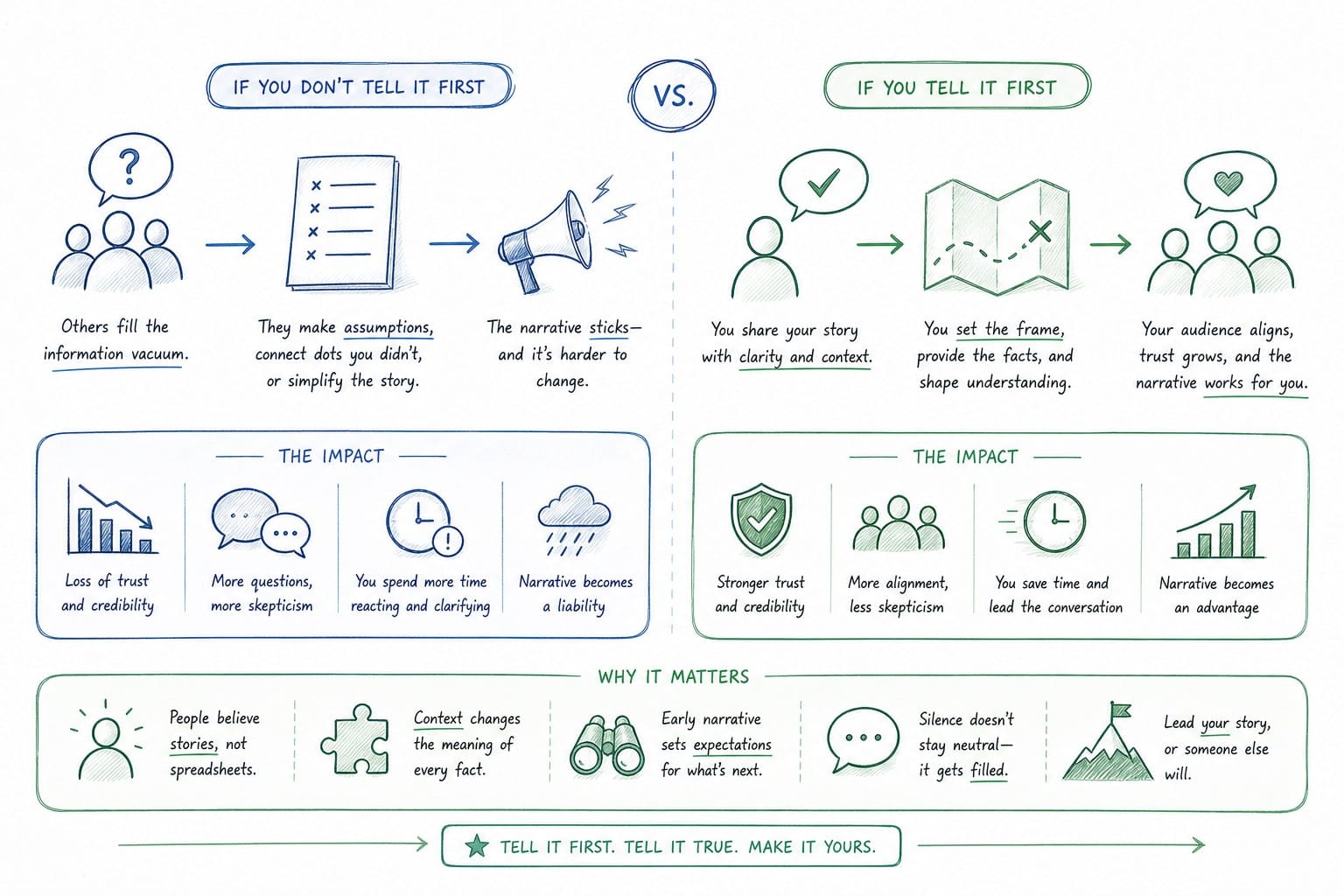
An agency's job is to execute a story. Their job is not to discover your story for you. When you hand off a product video project without a clear narrative, the agency fills the gap with whatever they know how to produce: a generic SaaS template with a voiceover that hits the usual beats. Problem, solution, features, call to action. It is competent. It is also forgettable.
The problem is that your product has a specific story. You know which customer pain point drove the first version. You know which feature closes deals. You know which workflow makes a buyer lean forward during a demo call. That knowledge lives in your head and in your CRM, not in a brief a producer reads once before writing a script.
Agencies are talented at production craft. They are not inside your product every day. They have not sat through 200 discovery calls. They have not watched a prospect lose interest at a specific screen transition. You have. That context is the raw material of a compelling product narrative, and no amount of onboarding meetings fully transfers it to an outside team.
There is also a timing problem. By the time an agency finishes a video, your product has often changed. A feature gets renamed. A UI flow gets simplified. A new capability ships that would have been the headline of the whole script. When you outsource the narrative, you also outsource the ability to keep it current. The agency owns the source files. You own a rendered export that ages fast.
This is especially true for pre-Series B B2B SaaS teams. You are moving fast. Your product is changing every sprint. Your homepage hero video, your sales deck walkthrough, your onboarding clip: all of them need to reflect what the product actually does right now, not what it did when you filmed it six weeks ago.
Owning your founder product video narrative means more than writing a bullet list of talking points. It means making three decisions before any production work starts.
First, you decide who the video is for. Not in a demographic sense. In a specific, behavioral sense. Is this video for a CFO who watches the first eight seconds of a homepage hero and then scrolls? Is it for a champion who needs to share a walkthrough with their IT team? Is it for a new user who opened the product for the first time and needs to see the core workflow before they quit? Each of those viewers needs a different entry point.
Second, you decide what one thing the viewer should understand after watching. Not five things. One. For most B2B SaaS products, the answer is something like: after watching this, the viewer should understand that our product removes the manual step they hate most. Everything else in the video supports that one idea or gets cut.
Third, you decide which screen or workflow is the proof point. Not the full feature set. The single workflow that makes the value obvious. The moment in a live demo where buyers actually nod. That is the scene your video needs to build toward.
Once you have those three decisions locked, you have a narrative. You can hand that to an agency, a contractor, or a tool and get something useful back. Without it, you are paying someone to guess.
I find that founders resist this work for two reasons. One is time. Narrative work feels abstract compared to product work, so it gets deprioritized. The other is false modesty. Founders sometimes believe that a trained storyteller will do a better job discovering the story than they will. That is true for craft, not for content. You are the expert on what your product does and why it matters. A scriptwriter is the expert on how to say it clearly. Both roles matter, but they cannot be swapped.
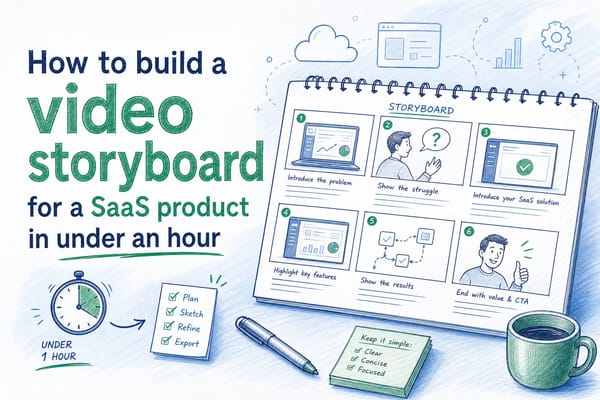
If you want a practical way to structure this narrative work before you involve any outside help, How to build a video storyboard for a SaaS product in under an hour walks through a fast, repeatable process for turning your product knowledge into a scene-by-scene structure.
What a strong founder product video narrative actually includes
Once you accept that the narrative is your responsibility, you need to know what a solid one looks like. This is not about writing a full script. It is about building the scaffolding that makes every downstream production decision easier and faster.
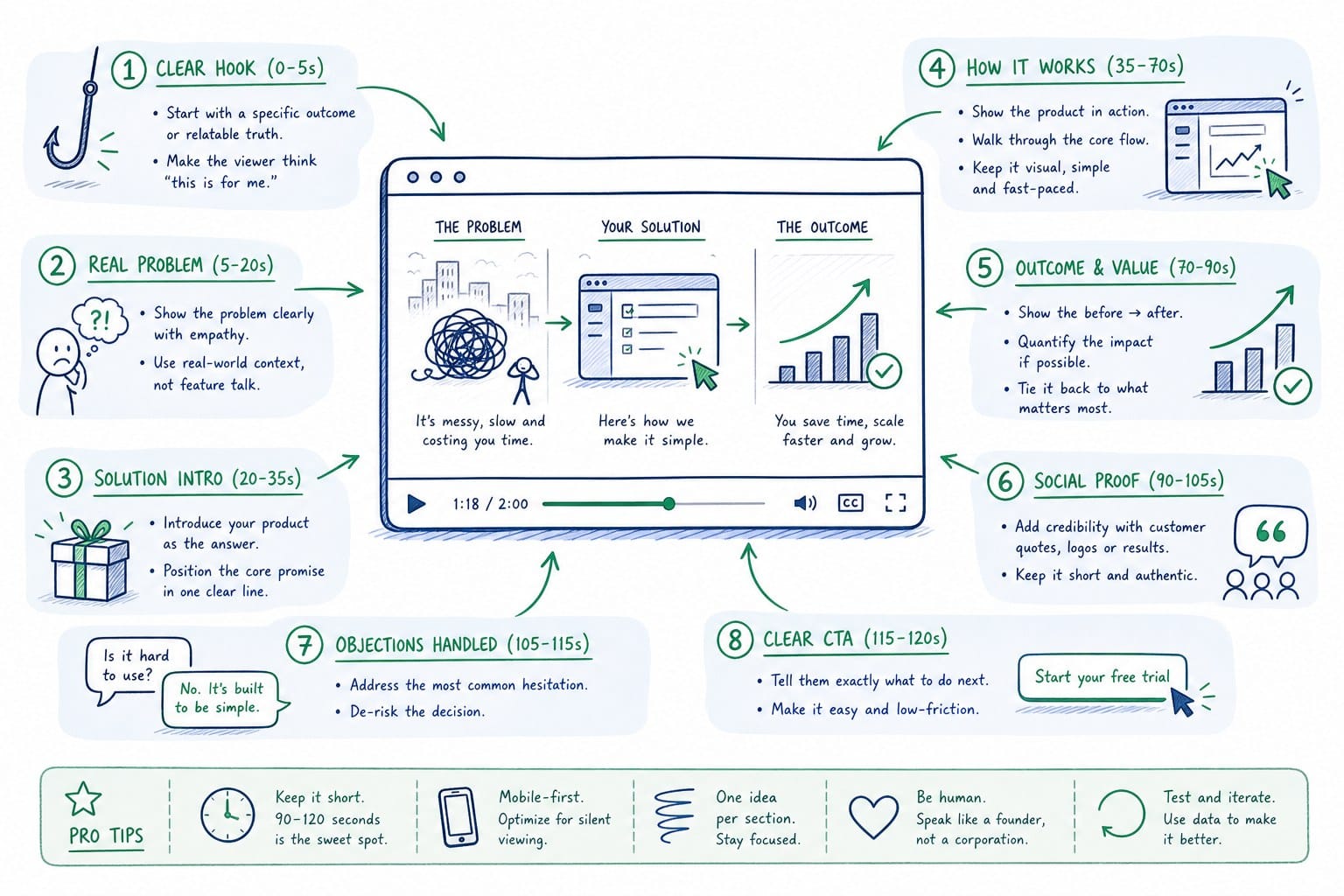
A strong product video narrative has five components. They do not need to be long. In fact, the shorter and more specific each component is, the better.
The first component is context setting. This is the one-sentence version of the world your buyer lives in before they find your product. It is not a market size claim. It is a behavioral description. Something like: most SDR teams still copy-paste data between their CRM and their outreach tool by hand every morning. That sentence is a context setter. It tells the viewer that you understand their day before you show them anything.
The second component is the friction moment. This is the specific, painful step that your product removes or dramatically improves. Not a category of pain. A specific moment. The friction moment is what makes a video feel relevant instead of generic. Buyers who recognize their own workflow in the first ten seconds of a video keep watching. Buyers who see a generic "streamline your workflow" message in the first ten seconds have already checked out.
The third component is the proof workflow. This is the screen recording, live product clip, or animated walkthrough that shows the friction moment being resolved. The proof workflow is not a full product tour. It is the shortest possible path from the problem to the resolution. If you can show the key action in 20 seconds, do not stretch it to 60 seconds because you want to show more features. More features dilute the narrative. They do not strengthen it.
The fourth component is the outcome statement. After the proof workflow, you need one clear sentence that names the result. Not a feature. An outcome. The difference is: a feature is "automated data sync." An outcome is "your SDRs start every morning with clean data and no manual work." Outcomes connect to business goals. Features connect to product specs. Buyers respond to outcomes.
The fifth component is the next step. Every product video is a piece of a funnel. What do you want the viewer to do next? Book a demo? Start a free trial? Share this clip with their team? The next step has to be explicit and it has to match where the viewer is in their buying journey. A homepage hero video has a different call to action than a sales deck walkthrough.
Those five components fit on a single page. You can build them in an afternoon if you come in with a clear head and a few notes from your best recent demos. Once you have them, you have a brief that any producer, contractor, or AI-powered tool can work from.
There is one more thing worth including in your narrative foundation: a maintenance plan. This is the part most founders skip entirely, and it is the part that costs them the most over time.
Product videos go stale fast. A study of SaaS product update cycles suggests most B2B SaaS products ship meaningful UI or workflow changes at least once a month. Some ship weekly. Every time a key screen changes, your existing video either becomes inaccurate or requires a re-edit. If your narrative is locked inside a production house's project files, every update is a new project negotiation. If your narrative is documented and owned by your team, every update is a targeted replacement of the specific scene that changed.
The difference in time and cost between those two approaches is significant. A targeted scene refresh on a video you own can take hours. A full agency re-engagement can take weeks and thousands of dollars. For a pre-Series B team, that difference compounds quickly across a quarter.
This is also why the format you choose for your product video matters as much as the narrative itself. A video built in a system that lets you regenerate individual segments from updated product footage gives your team the ability to keep the narrative current without starting over. A video that exists only as a final export gives you no such option.
I covered a related version of this problem in the context of onboarding videos in How customer success teams keep onboarding videos current after every UI update. The same principle applies to every video type your team produces. The narrative is the constant. The footage is the variable. When you can update the footage without rebuilding the narrative, you save an enormous amount of time across a product's life.
One practical way to stress-test your narrative before you move into production is to read it aloud to someone who has never seen your product. Not a technical user. Not a fellow founder. A smart person with no context. Ask them to tell you what the product does after you read the five components. If their answer matches your intended message, your narrative is clear. If it does not, you have a clarity problem that production polish will not fix. Better to find that out in a 20-minute conversation than after six weeks of production work.
Another test is to check whether your narrative survives a product update. Take your five components and ask: if we ship a significant UI change next month, which of these components breaks? The context setting and friction moment should be almost entirely stable. They describe your buyer's world, not your product's interface. The proof workflow will need to update. The outcome statement and next step should be stable unless your positioning changes. If you build your narrative this way, you already know which part to refresh when your product ships. That is a far better position than discovering after the fact that your whole video is outdated.
How to work with an agency or a production tool once your narrative is solid
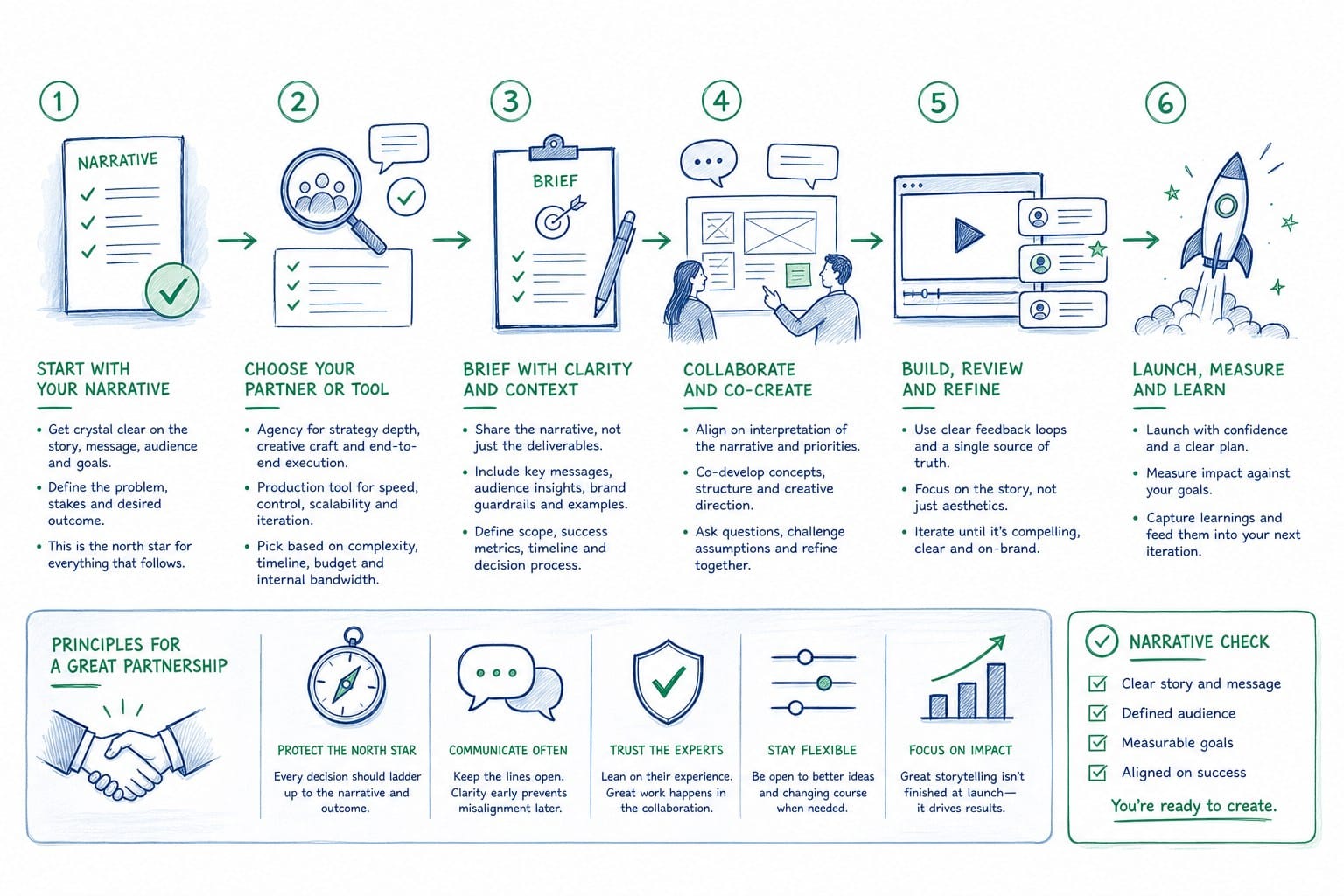
Once you own the narrative, working with outside help gets dramatically more efficient. You are no longer asking someone to discover your story. You are asking them to execute it. That shift changes the entire dynamic of the engagement.
When you bring an agency a solid narrative brief, the first thing that changes is scope. Instead of an open-ended discovery phase where the agency tries to learn your business, you start with a defined structure. The agency's job becomes finding the best way to produce the five components you have already defined. That is a much more contained problem, and it typically results in a faster timeline, fewer revision rounds, and a final product that actually represents your product the way you intended.
The second thing that changes is revision quality. When you do not own the narrative, feedback rounds tend to be vague. "This does not feel right." "The tone is off." "I want it to feel more like us." Those are hard notes to act on. When you own the narrative, your feedback is specific. "The proof workflow you built goes through the settings panel, but we need it to show the main dashboard workflow because that is the scene that closes deals." That is an actionable note. The agency knows exactly what to change and why.
The third thing that changes is longevity. When the narrative is yours, you can brief any future agency, contractor, or tool from the same foundation. You are not starting from scratch every time you need a new video format. You have a documented story that travels with your product. A social cut, a homepage hero, a sales deck walkthrough, and an onboarding clip can all share the same narrative spine with format-specific adjustments.
For teams that want to reduce their dependence on agencies entirely, tools that generate video from product footage or product URLs have become a practical option for maintaining an always-current library of product clips. This approach works especially well when the narrative is already owned by the team, because the tool is executing against a defined structure rather than inventing one. The founder or PMM controls the narrative. The tool handles the production. Updates happen at the team's own pace, not on an agency's project schedule.
This matters especially for the types of video that change most often. Homepage heroes need to reflect the current product, not the version from the last agency shoot. Sales deck walkthroughs need to match the product your AE is actually demoing, not the version that was live when the video was produced. Onboarding clips need to show the interface your new users are actually looking at. Each of these videos benefits from a team that can refresh the footage without rebuilding the narrative from scratch.
For teams evaluating different production approaches, it is worth understanding what different tools and formats are actually designed for. Arcade vs Loom for SaaS product video: a B2B team comparison breaks down how two commonly used tools compare for B2B product teams, which helps clarify where a more structured narrative-first video approach fits relative to lighter-weight options.
The most common mistake I see founders make after they have a solid narrative is treating it as a one-time document. They write the five components, use them for one video project, and then forget the brief exists. The next time they need a product video, they start from scratch or hand a new agency an outdated brief.
A better approach is to treat your narrative brief as a living document. Review it any time your positioning changes. Update the proof workflow component any time you ship a significant UI change. Revisit the friction moment any time your customer discovery reveals a sharper or more precise pain point. Keep the document in a shared location your PMM, CS lead, and sales team can all access.
When your narrative is visible and shared, your team makes better decisions about video content across every function. Your CS team is not building onboarding clips that contradict the story your sales team is telling. Your growth team is not posting social cuts that lead with a feature your homepage hero does not mention. Your narrative becomes the connective tissue that keeps your product story consistent across the full customer journey.
There is also a confidence benefit that founders underestimate. When you know your narrative, you show up differently in investor conversations, in media appearances, and in customer meetings. The clarity you develop by working through your five narrative components is not just useful for video production. It is useful every time you have 90 seconds to explain what your product does and why it matters. The discipline of building a founder product video narrative is partly a video discipline and partly a thinking discipline.
If you are a founder who has been avoiding this work because it feels like a marketing task rather than a product task, I want to push back on that framing. Narrative clarity is a product decision. Deciding which workflow is the proof point is the same kind of decision as deciding which feature to build next. It requires the same understanding of your customer, the same knowledge of your competitive landscape, and the same judgment about what creates real value. The founders who do this work well are not primarily marketers. They are product thinkers who understand that the story of what their product does is inseparable from the decisions about what their product is.
Owning that story before you hire anyone to produce it is not an optional preliminary step. It is the work itself. Everything else is execution.
Ready to take the next step?
Product Frames is built for exactly this kind of team: founders and GTM leads who own their narrative and need a way to keep their product videos current after every sprint without going back to an agency. You paste in your product URL or upload existing footage, and Product Frames generates an editable, narrated video composition you can refresh as your product changes. One credit equals one second of finished video, so you only pay for what you actually produce. If you want to see how it works with your own product, visit productframes.com and start a project today.